
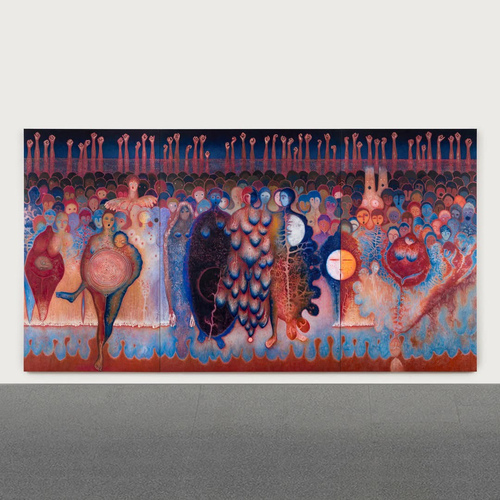
The female procession marching on Art Basel Miami Beach 2025: the monumental work by Luisa Rabbia
By Davide Landoni
December 9, 2025
Exhibited in the Meridians section of the fair—the one dedicated to monumental, larger-than-life works—the triptych revisits The Fourth Estate by Pellizza da Volpedo, highlighting women’s capacity to unite in order to obtain and protect their rights.
In the large triptych The Network, painted by Luisa Rabbia in 2025, the figures emerge from the canvas as if rising from living earth. The female bodies appear rooted in the very support, generated by an interlacing of lines that recall veins, filaments, cellular systems. It is this compound of matter and movement that strikes first: a silent advance that transforms the painting’s monumentality into an almost physical presence. In the Meridians section of Art Basel Miami Beach 2025 (December 2–7)—the area dedicated to monumental, larger-than-life works—curator Yasmil Raymond selected the piece precisely for its ability to expand space and invite the viewer into a shared rhythm rather than a linear narrative.
Rabbia revisits the procession of The Fourth Estate by Pellizza da Volpedo and transforms it into a choral advance of female figures. Equally striking is the exact coincidence in scale between the two works: 293 × 545 cm. This is not a quotation, but a shift in meaning. The workers’ march is translated into another history—that of women’s rights, threatened and therefore defended across generations. The protagonists emerge from a fabric of roots and cells, an organic structure that both binds and supports them. Within the group, presences belonging to myth can be discerned, such as the echo of Artemis of Ephesus, a symbol of generative energy that exceeds individual identity and expands until it becomes a collective gesture.
The crowd advances as a single body. The roots connecting the figures are not mere ornament, but a metaphor for a support system that women have quietly built over time. It is an interweaving that speaks of resilience, but also of ancient knowledge—that of Neolithic and Paleolithic goddesses whom the artist invokes to recall the continuity between human beings and nature. Among the women appear spirits that amplify the chorus, voices pushed to the margins for centuries and now resurfacing as a luminous counterpoint to pain.
The surface of the painting is crossed by a constellation of imprints. Rabbia presses her fingers into the preparatory plaster, a simple gesture that becomes a declaration of responsibility. Each imprint is a trace added to the others, a memory that accumulates in layers, evidence of the bond between the one who creates and the world that receives the work. The material crumbles into particles reminiscent of cells and cosmic dust, as if the painting were born from an ongoing dialogue between micro and macro, between interiority and landscape.
In recent years, the artist has developed a trajectory that moves through suffering, mythology, and biology. The drawings on Dante’s Inferno, created in the post-pandemic period, opened a reflection on the deepest emotional states. The series The Gods then wove together myth and current events, questioning the distance between nature and the human condition. The Network seems to gather all these directions and carry them into a broader form, one that approaches a consciousness concerning both the individual and the collective.
Meridians offers the work a framework that allows its complexity to emerge without forcing it. The triptych does not demand immediate interpretation. Rather, it invites the viewer to pause, to be permeated by a presence that advances slowly and compactly. The figures move toward the viewer with a step that is neither march nor procession, but a form of continuity between past and present. A movement that promises no solutions, yet suggests the possibility of a different future—a space in which voices, at last, no longer proceed in isolation.